About Cache Valley Roofing
HOW WE EARN TRUST ON SOMETHING YOU CAN'T INSPECT YOURSELF
You Shouldn't Have to Take Our Word for It
Hiring a roofer means paying real money for work on the one part of your house you will never climb up and check. The industry knows that, and a certain slice of it is built entirely around it: the door-knock after a windstorm, the free inspection that always discovers five figures of urgent damage, the wall of logos that turns out to be a supplier list, the estimate that arrives as a single number with no way to compare it to anyone else's.
Cache Valley Roofing is built the other way around. Not on promises about our character, because every roofer makes those. On a way of working where you don't have to believe us: photographs of everything we find, an estimate broken into lines you can hold against any other bid in the valley, and a written answer that says what the roof needs rather than what we'd prefer to sell. If the pictures don't support the recommendation, don't hire us. That's the entire point.

All
Residential, Commercial & Agricultural
9
CACHE COUNTY COMMUNITIES
100%
LICENSED & INSURED IN UTAH
Free
ROOF INSPECTIONS
Every inspection comes back down the ladder with photos, and they're yours
Whatever we find, and whatever we don't, gets photographed and tied to a location on your roof. Lifted shingles, a split pipe boot, frost on the underside of your decking, or nothing at all. You keep that file whether you hire us, hire someone else, or decide to wait two years. It means the next conversation you have about this roof starts from evidence instead of from somebody's word, including ours.
Every estimate is line-item, and it holds
Materials, tear-off, disposal, permits, ventilation, and decking priced per sheet before the tear-off starts, so "we found some bad plywood up here" arrives as a number you already approved rather than a phone call on day two. Lump-sum bids hide padding and make comparison impossible, which is usually the point of them. A contractor confident in their pricing wants you comparing.
We open the attic hatch, because that's where half the answers are
Most roofing inspections in this valley stop at the shingles, and in a climate that runs on ice dams that's half an inspection. We measure insulation depth, check whether the soffit vents are actually clear, look for frost staining on the deck, and find the bath fan venting into the attic. Plenty of roofs we're called out to look at don't have a roofing problem at all. They have an attic problem that's been showing up as a stain on the ceiling every March.
We say so when the cheaper fix is the right fix
A meaningful share of our inspections end with a repair recommendation or with "this roof has several winters left in it." A $600 flashing repair that buys five years is a better outcome for you than a replacement you didn't need, and we'd rather be the company you call in five years than the one you regret this year. When storm damage is close to your deductible, we'll run that math with you before you file rather than after.
Built for Cache Valley Winters, Specifically
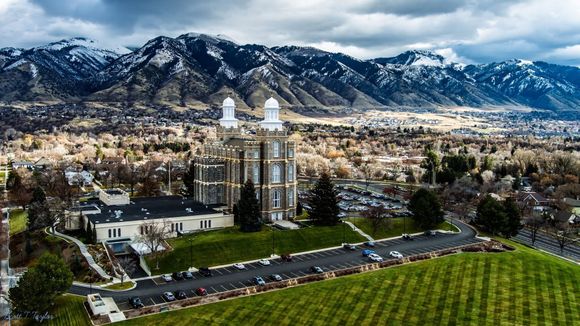
We work one place: Logan and Cache Valley, from the century-old homes in the Center Street and Adams districts to the bench subdivisions in North Logan and Providence, out to the dairy barns and machine sheds around Amalga, Lewiston, and Richmond. That focus matters, because this valley breaks roofs in ways that most of the roofing industry isn't solving for.
Roughly two hundred freeze-thaw cycles a year work sealant loose, open flashing seams, and back fasteners out a fraction at a time. North-facing slopes carry snow from Thanksgiving into March and age at roughly twice the rate of the sunny side of the same roof. During a hard inversion stretch, eaves can sit below freezing for weeks while heat escaping your attic quietly melts the snowpack from underneath, which is the entire recipe for an ice dam. Wind funneling out of Logan and Sardine canyons creases shingles that lay back down looking untouched while their seal is permanently broken. And a wet March storm landing on a settled base is a structural question rather than a maintenance one, especially on the outbuildings nobody has walked on since the eighties.
So everything we specify is chosen for that. Cold-flex and SBS polymer-modified shingles that stay flexible in deep cold. Ice-and-water shield run past code minimum at eaves and valleys, because the code line assumes an average winter and this valley doesn't have those. Six-nail fastening in the canyon-wind zones. Open metal valleys that move ice instead of holding it. Ventilation calculated for your attic rather than copied from whatever was there before. A roofer optimizing for UV exposure is solving a real problem, just not the one your roof has.
How to Vet Any Roofer, Including Us
This is the checklist we'd give a family member, and we're happy to be measured against it. Most of it takes five minutes and it will separate the serious contractors from the rest faster than any review page.
Verify the license and the insurance before anyone starts. Utah's Division of Occupational and Professional Licensing keeps a free public lookup, and thirty seconds confirms whether a contractor's license is real and current. Ask for proof of general liability and workers' compensation in writing too. If a crew member is hurt on an uninsured job at your house, that can become your problem. Any professional expects this question and has the documents ready.
Ask what they'll do about your attic. In a valley that runs on ice dams, this is the single fastest way to sort roofers. Ask where the ice-and-water shield stops, whether they'll check your insulation and ventilation, and what they think is causing the ice at your eaves. A roofer who answers "code minimum, twenty-four inches" and changes the subject is quoting you the same roof they'd quote in Provo.
Ask three specific installation questions. Factory starter strip and factory ridge caps, or cut-up field shingles? How many nails per shingle? Where does the underlayment change and why? Manufacturers' high-wind warranties require the first two, and they're exactly the lines a cheap bid quietly removes. Specific answers mean a crew that does this regularly. Vague answers tell you something too.
Demand photos with the diagnosis. Any legitimate finding can be photographed. "Trust me, it's bad up there" is not an inspection, it's a sales technique, and it only works because you can't go look.
Get it itemized, and get the warranty in writing. Lump sums hide padding. And there are two separate warranties on a roof: the manufacturer's material warranty, which has to be registered to exist, and the contractor's workmanship warranty, which is only worth as much as the company standing behind it. Ask for both in writing, and ask specifically who registers the manufacturer warranty.
Ask who pulls the permit. Logan City permits differently than the smaller valley towns and differently again than unincorporated Cache County. A roofer who works here knows that without checking. A contractor who suggests skipping the permit is telling you how they handle everything else.
Ask whether they answer the phone in February. Ice dams and snow load don't wait for spring, and a roof that fails in January can't be scheduled for April. Plenty of outfits are reachable in July and unreachable when the valley is actually hard on roofs.
Walk away from same-day pressure. Real roof problems get documented and quoted, and they don't expire at sunset. "This price is only good today" is a sales tactic wearing a tool belt. The roof survived the storm; it will survive a week of you getting other bids.
Be especially careful after a windstorm. If someone you didn't call is on your porch promising insurance will cover everything, slow down. Never sign an Assignment of Benefits or a contingency agreement on a doorstep, and be aware that any offer to "cover" or "eat" your deductible is insurance fraud, not a favor. Our storm damage page covers this in detail.
- If a roofer fails this list, don't hire them. We wrote it expecting to be held to it.
Serving All of Cache Valley
Based in Logan at 700 W 200 N, working throughout Cache County:
Logan · Hyrum · Richmond · Wellsville · North Logan · Hyde Park · Smithfield · Providence · Nibley
Also serving Millville, River Heights, Mendon, Paradise, and the surrounding county.
Hold Us to Our Own Checklist
The inspection costs nothing, the photos are yours to keep, and the estimate is itemized. Judge us against the checklist above. We wrote it expecting you to.
Or Call: 801-880-2885