Roof Snow Removal in Logan, Utah
Most winters, most valley roofs carry their snow just fine; modern homes here are engineered for serious loads and the dry January powder is lighter than it looks. The problem arrives two ways. The first is the wet spring storm, the heavy March dump that lands on top of a compacted season's base and doubles the load in a night. The second is the building that was never engineered to modern numbers at all: the pre-code farm buildings, the long-span machine sheds, the flat-roofed additions, and the carports that fail first in every hard winter the valley has ever had.
Cache Valley Roofing takes the load down safely: roof rakes and proper technique on homes, staged removal on ag buildings, and honest triage on the phone about whether your situation is a today problem or a watch-it situation. What we never do is shovel to bare shingles, because a scraped roof trades a load problem for a leak problem and usually voids what's left of the shingle warranty.
Get Your Snow Removal Roof Inspection
How Much Snow Is Too Much on a Roof?
Weight, not depth, is the number that matters, and water content decides weight:
Weight, not depth, is the number that matters, and water content decides weight. Rain falling on an existing snowpack is the fastest way a safe load becomes an unsafe one.
Utah building code sets required ground snow loads town by town, and Cache Valley's numbers run well above most of the state's populated areas. A code-built valley home has real margin. The arithmetic gets tight when a wet storm lands on a deep settled base, when drifting piles the leeward slope two or three times deeper than the rest of the roof, or when the structure predates the code entirely. Rain on snow is the worst case in the table: the snowpack absorbs it like a sponge and the load jumps in hours.
Warning Signs Your Roof Is Overloaded
Call the day you notice any of these, not after the next storm:
- Interior doors that suddenly stick upstairs, or new gaps at door tops: the frame is racking as the structure deflects.
- New drywall cracks radiating from door and window corners, or along the ceiling line.
- A visibly sagging ridge line or rafter bellies, best spotted from across the street or from inside the attic.
- Creaking, popping, or cracking sounds from the roof structure, especially during or right after a storm.
- On ag and outbuildings: bowed purlins, doors that won't slide, and visible deflection in the long spans. These buildings give less warning and fail faster than homes; walk them after every major storm.
None of those signs? Then judge by the table above and the drifts, not by panic. Plenty of valley roofs carry two feet of powder without a complaint.
Roof Snow Removal Services We Offer
Residential Snow Load Reduction
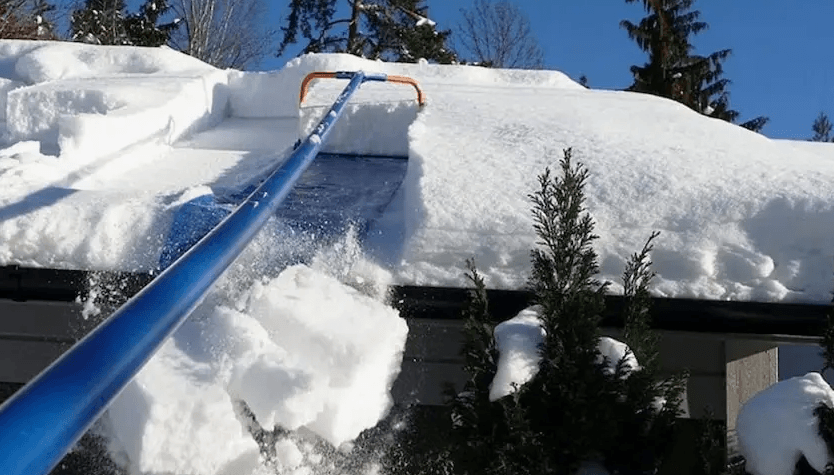
Roof-rake and staged removal that leaves a protective couple of inches of snow on the shingles. We work the drift zones and valley accumulations where the real weight concentrates, not just the photogenic eave line.

Farm & Outbuilding Snow Removal
Barns, machine sheds, hay covers, and shops, including the long-span and pre-code structures that carry the valley's real collapse risk. Multi-structure properties get one visit and per-building triage: which roof needs relief today and which can wait.

Flat-Roof and Low-Slope Snow Clearing
The flat-roofed additions, commercial roofs, and parapet sections where snow doesn't shed at all and drains freeze shut. Cleared to the membrane's safety margin with drain paths opened, never scraped to the surface.

How Do You Remove Snow From a Roof Without Damaging It?
Almost none of it happens with a shovel, and most of it happens with our feet on the ground. Here's the actual method, because it's the difference between a roof that's lighter and a roof that leaks in April:
- Telescoping roof rakes with rolling heads, worked from the ground. Poles reach past twenty feet, and the head rides on a cushion of snow rather than riding on your shingles. Slide-sheet designs (the Avalanche!-style rakes and Roof Razor being the ones most homeowners recognize) shear a slab loose and let it ride down a poly sheet with nothing scraping the roof at all.
- A sacrificial layer always stays. We leave one to two inches on the surface, every time. The blade never touches roofing. That single rule is most of what separates a roofing crew from a laborer with a truck, and it's why our removals don't create spring repair calls.
- Snow comes off in courses, not slabs. Cutting manageable horizontal sections keeps the work controlled. Levering off a big frozen slab can pry shingles loose, tear a gutter off the fascia, or come down on whoever is underneath it.
- Balanced, side to side. Load comes off evenly rather than stripping one slope while the opposite side stays fully loaded, which twists a frame in ways it was never designed for.
- Fall protection whenever the roof gets walked. Harness, rope, and temporary anchors, with two people on site. Snow-covered roofs hide every edge, valley, and skylight; a slope you'd walk without thinking in July is a different object in February.
- Poly shovels only, never metal. For the hand work at valleys, dead spots, and around penetrations. Metal blades and ice chippers are how eave damage happens.
- Ice gets steam, not force. When the bottom of the pack has turned to ice at the eaves, that's a dam, and it comes off with heat rather than muscle. Details on our ice dam removal page.
- We map the hazards before the first rake goes up. Plumbing vents, furnace and water heater flues, satellite mounts, skylights, solar arrays, and swamp cooler housings are all invisible under two feet of snow and all breakable. We walk the property and mark them first.
- Drop zones get planned. That snow has to land somewhere, and it shouldn't be on your AC condenser, gas meter, propane tank, or the one door you use. On flat and commercial roofs there's a second rule: never pile removed snow in one spot. A pile is a concentrated point load, and it can stress a deck worse than the even blanket you just took off.
- Metal roofs get handled from the ground. A seam roof can release its entire load without warning, so we work the slide paths from outside them rather than standing in one.
What Roof Snow Removal Costs in Logan
Typical Cache Valley market ranges; estimates only. Pricing moves with roof size, pitch, snow depth and density, and access; we quote honestly on the phone from your description and photos.
Pricing moves with roof size, pitch, snow depth and density, and access. We quote honestly on the phone from your description and photos, and we'll also tell you honestly when your roof doesn't need us yet.
"Most valley roofs never need clearing. What you're paying for is knowing which ones do, and when."
Our Snow Removal Roofing Process
01
Phone Triage
Describe the building, the snow, and the warning signs; send photos if you can. We'll tell you plainly: today, this week, or you're fine. Overloaded structures jump every queue we have.
02
Staged Removal
Load comes off in balanced stages (never one slope stripped while the opposite slope stays loaded, which torques the structure), with a protective snow layer left on the roofing.
03
The Walkaround
Eaves, gutters, vents, and visible structure checked and photographed after the load is off, so you know what winter's been doing under there.
04
The Honest Debrief
If this is a one-off wet-storm situation, we say so. If your building is going to need us every February, we'll price the permanent conversations: retention, ventilation, or the structural assessment an engineer should make.
Why Choose Cache Valley Roofing for Snow Removal
Roofers first, shovelers never
Snow removal crews that don't understand roofing remove snow and shingle granules together. Our technique standard exists because we're the ones who see scraped-roof damage every spring, and we decline to create it.
We know the valley's buildings
A code-built Nibley two-story and a 1950s hay barn near Amalga are different risk conversations, and we triage them differently instead of selling both the same urgency.
Balanced-load method
Removal order matters structurally. Stripping one side of a loaded roof stresses the frame in ways it wasn't built for; our staged pattern takes weight down evenly.
Snow Removal FAQS
When in Doubt, Ask Before the Next Storm
A phone call and a couple of photos gets you a straight answer about your roof's load, free. The wrong week to find out is the week after the wet one.
Or Call: 801-880-2885


